PMMVY 2026
Pradhan Mantri Matru Vandana Yojana (PMMVY) 2026 – Complete Guide
Pradhan Mantri Matru Vandana Yojana (PMMVY) is one of the Government of India's most important maternity benefit schemes, designed to provide financial assistance to pregnant women and lactating mothers while encouraging timely healthcare during pregnancy.
What is PMMVY?
Pradhan Mantri Matru Vandana Yojana (PMMVY) is a maternity benefit scheme run by the Government of India that gives cash support to pregnant women and new mothers. The goal is simple: help women rest, eat well, and get proper medical care during pregnancy without worrying as much about lost wages.
Under PMMVY 2.0, money is paid directly into the mother's Aadhaar-linked bank account for her first living child, and again for a second child if that child is a girl. There's no cash handling and no middlemen — payments move through the Direct Benefit Transfer (DBT) system, so the process is traceable end to end.
PMMVY encourages the following important healthcare practices:
- Pregnancy gets registered early
- Antenatal check-ups happen on schedule
- Delivery happens at a proper medical facility
- The newborn gets vaccinated on time
If you're trying to figure out how to register, log in to check your status, or track your payment, this guide walks through each step using the latest 2026 process.
Objectives of PMMVY
PMMVY isn't just about handing out money — it's designed to change behavior around pregnancy and childbirth in ways that improve health outcomes. The scheme works toward a few connected goals:
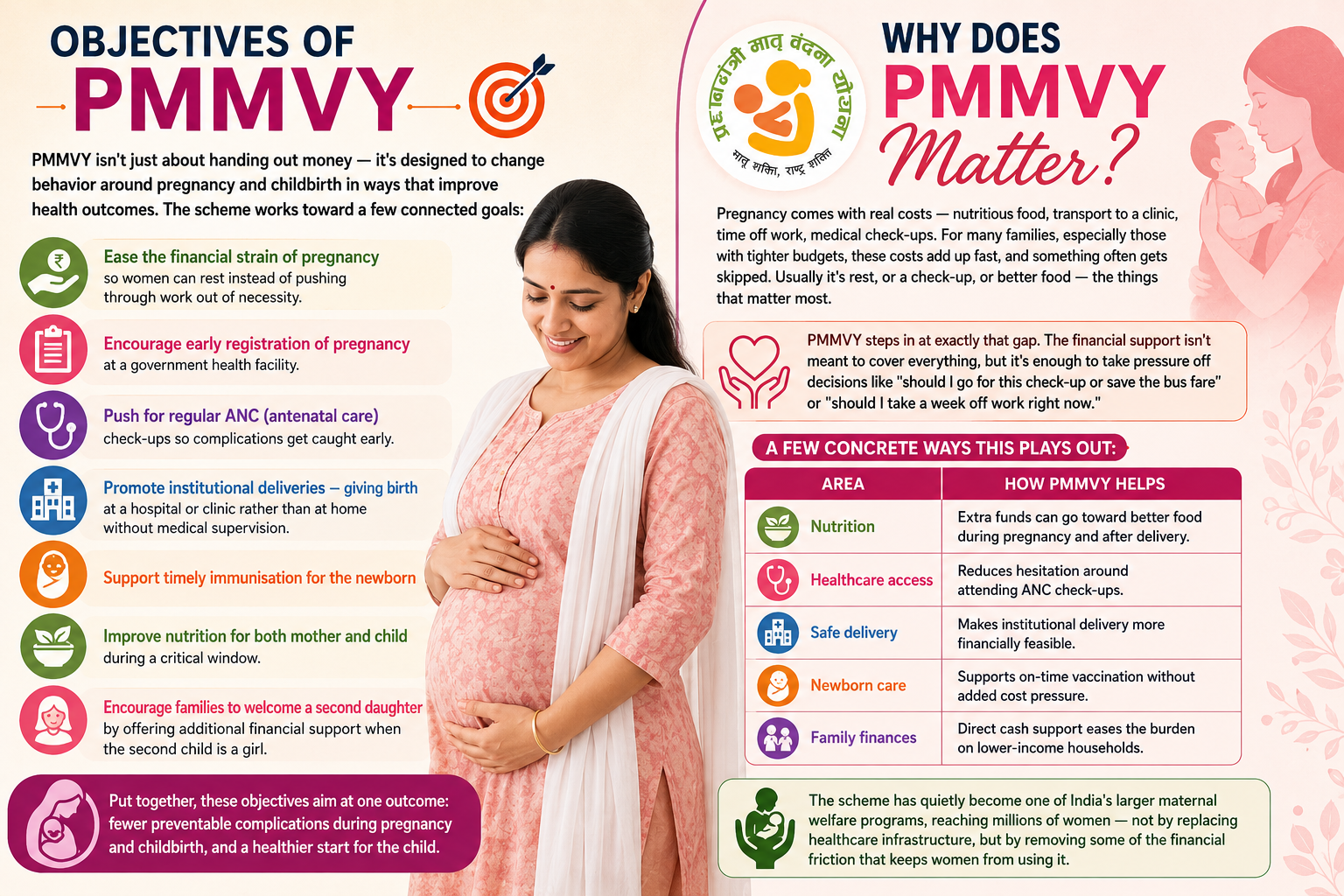
Ease the financial strain of pregnancy so women can rest instead of pushing through work out of necessity.
Encourage early registration of pregnancy at a government health facility.
Push for regular ANC (antenatal care) check-ups so complications get caught early.
Promote institutional deliveries — giving birth at a hospital or clinic rather than at home without medical supervision.
Support timely immunisation for the newborn.
Improve nutrition for both mother and child during a critical window.
Encourage families to welcome a second daughter by offering additional financial support when the second child is a girl.
Put together, these objectives aim at one outcome: fewer preventable complications during pregnancy and childbirth, and a healthier start for the child.
Why Does PMMVY Matter?
Pregnancy comes with real costs — nutritious food, transport to a clinic, time off work, medical check-ups. For many families, especially those with tighter budgets, these costs add up fast, and something often gets skipped. Usually it's rest, or a check-up, or better food — the things that matter most.
PMMVY steps in at exactly that gap. The financial support isn't meant to cover everything, but it's enough to take pressure off decisions like "should I go for this check-up or save the bus fare" or "should I take a week off work right now."
A few concrete ways this plays out:
Extra funds can go toward better food during pregnancy and after delivery.
Reduces hesitation around attending ANC check-ups.
Makes institutional delivery more financially feasible.
Supports on-time vaccination without added cost pressure.
Direct cash support eases the burden on lower-income households.
The scheme has quietly become one of India's larger maternal welfare programs, reaching millions of women — not by replacing healthcare infrastructure, but by removing some of the financial friction that keeps women from using it.
PMMVY Eligibility Criteria 2026
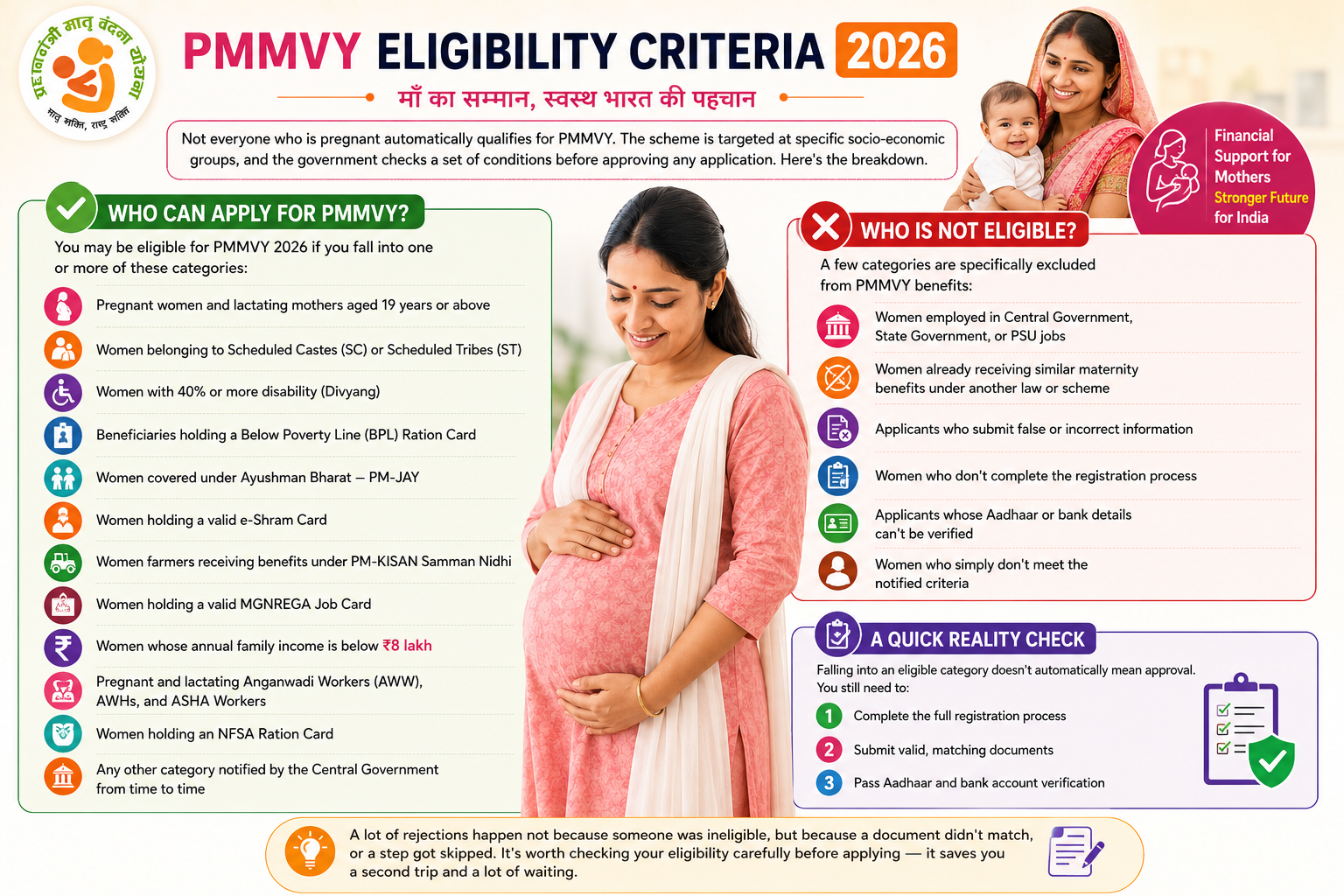
Not everyone who is pregnant automatically qualifies for PMMVY. The scheme is targeted at specific socio-economic groups, and the government checks a set of conditions before approving any application. Here's the breakdown.
Who Can Apply for PMMVY?
You may be eligible for PMMVY 2026 if you fall into one or more of these categories:
- Pregnant women and lactating mothers aged 19 years or above.
- Women belonging to Scheduled Castes (SC) or Scheduled Tribes (ST).
- Women with 40% or more disability (Divyang).
- Beneficiaries holding a Below Poverty Line (BPL) Ration Card.
- Women covered under Ayushman Bharat – PM-JAY.
- Women holding a valid e-Shram Card.
- Women farmers receiving benefits under PM-KISAN Samman Nidhi.
- Women holding a valid MGNREGA Job Card.
- Women whose annual family income is below ₹8 lakh.
- Pregnant and lactating Anganwadi Workers (AWW), AWHs, and ASHA Workers.
- Women holding a valid NFSA Ration Card.
- Any other category notified by the Central Government from time to time.
Who Is Not Eligible?
A few categories are specifically excluded from PMMVY benefits:
- Women employed in Central Government, State Government, or PSU jobs.
- Women already receiving similar maternity benefits under another law or scheme.
- Applicants who submit false or incorrect information.
- Women who don't complete the registration process.
- Applicants whose Aadhaar or bank details can't be verified.
- Women who simply don't meet the notified criteria.
A Quick Reality Check
Falling into an eligible category doesn't automatically mean approval. You still need to:
Complete the full registration process.
Submit valid, matching documents.
Pass Aadhaar and bank account verification.
A lot of rejections happen not because someone was ineligible, but because a document didn't match, or a step got skipped. It's worth checking your eligibility carefully before applying — it saves you a second trip and a lot of waiting.
PMMVY Benefits & Financial Assistance (2026)
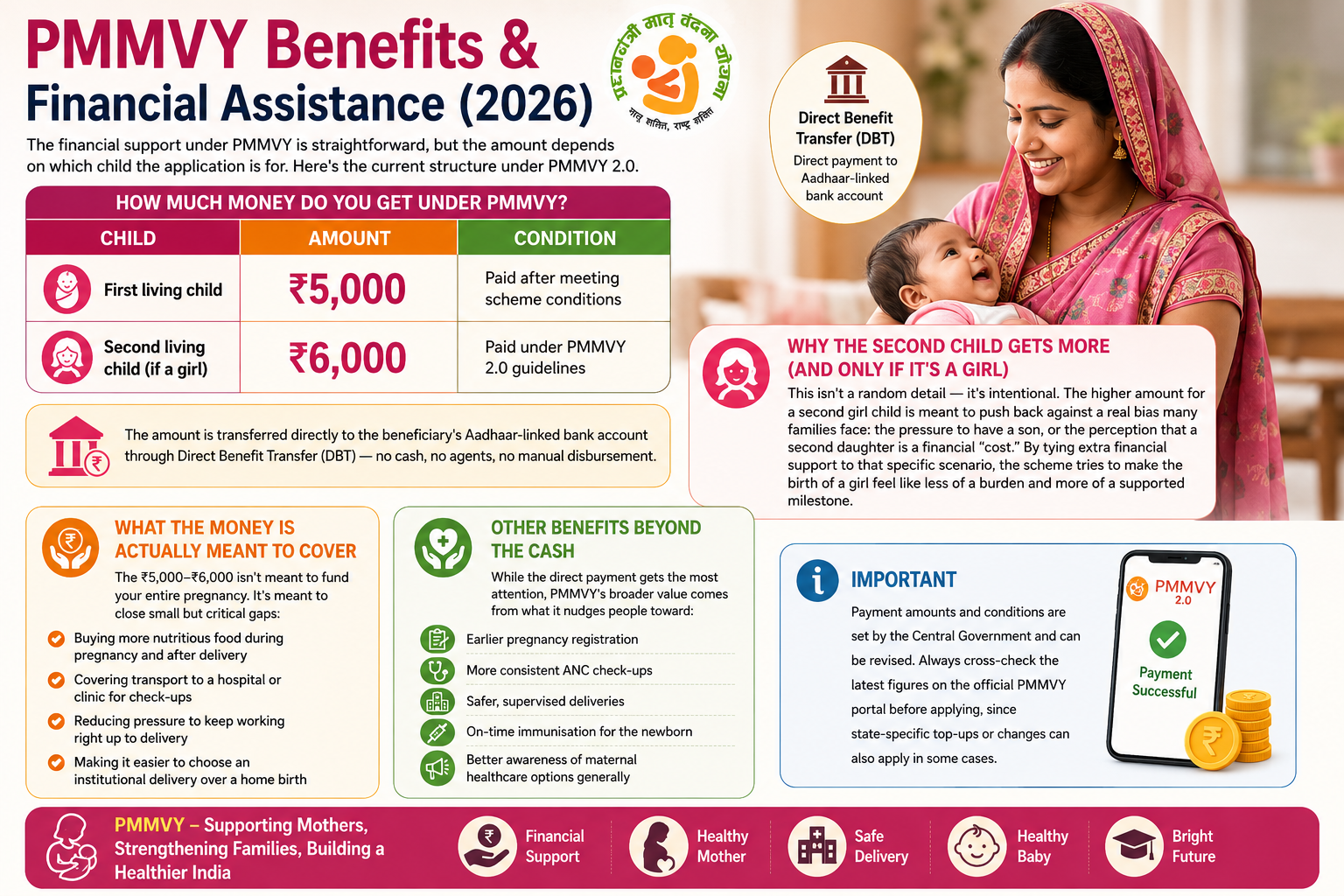
The financial support under PMMVY is straightforward, but the amount depends on which child the application is for. Here's the current structure under PMMVY 2.0.
How Much Money Do You Get Under PMMVY?
| Child | Amount | Condition |
|---|---|---|
| First living child | ₹5,000 | Paid after meeting scheme conditions |
| Second living child (if a girl) | ₹6,000 | Paid under PMMVY 2.0 guidelines |
Direct Benefit Transfer (DBT)
The amount is transferred directly to the beneficiary's Aadhaar-linked bank account through Direct Benefit Transfer (DBT) — no cash, no agents, and no manual disbursement.
Why the Second Child Gets More (and Only If It's a Girl)
This isn't a random detail — it's intentional. The higher amount for a second girl child is meant to push back against a real bias many families face: the pressure to have a son, or the perception that a second daughter is a financial "cost."
By tying extra financial support to that specific scenario, the scheme tries to make the birth of a girl feel like less of a burden and more of a supported milestone.
What the Money Is Actually Meant to Cover
The ₹5,000–₹6,000 isn't meant to fund your entire pregnancy. It's meant to close small but critical gaps:
Nutritious Food
Buying more nutritious food during pregnancy and after delivery.
Hospital Travel
Covering transport to a hospital or clinic for check-ups.
Reduced Work Pressure
Reducing pressure to keep working right up to delivery.
Safe Delivery
Making it easier to choose an institutional delivery over a home birth.
Other Benefits Beyond the Cash
While the direct payment gets the most attention, PMMVY's broader value comes from what it nudges people toward:
Earlier pregnancy registration
More consistent ANC check-ups
Safer, supervised deliveries
On-time immunisation for the newborn
Better awareness of maternal healthcare options generally
Important
Payment amounts and conditions are set by the Central Government and can be revised. Always cross-check the latest figures on the official PMMVY portal before applying, since state-specific top-ups or changes can also apply in some cases.
Documents Required for PMMVY Registration (2026)
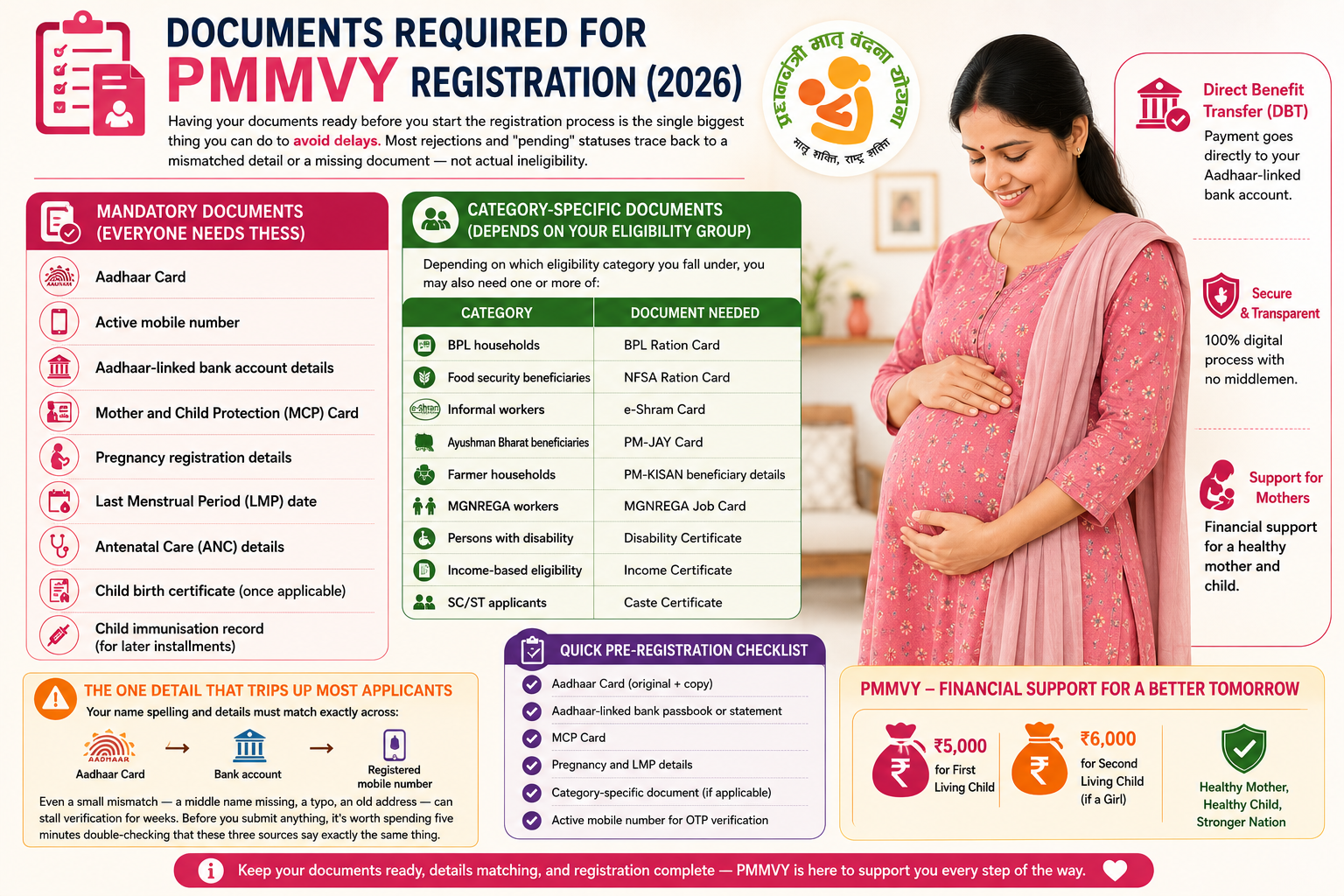
Having your documents ready before you start the registration process is the single biggest thing you can do to avoid delays. Most rejections and "pending" statuses trace back to a mismatched detail or a missing document — not actual ineligibility.
Mandatory Documents (Everyone Needs These)
Category-Specific Documents (Depends on Your Eligibility Group)
Depending on which eligibility category you fall under, you may also need one or more of:
| Category | Document Needed |
|---|---|
| BPL households | BPL Ration Card |
| Food security beneficiaries | NFSA Ration Card |
| Informal workers | e-Shram Card |
| Ayushman Bharat beneficiaries | PM-JAY Card |
| Farmer households | PM-KISAN beneficiary details |
| MGNREGA workers | MGNREGA Job Card |
| Persons with disability | Disability Certificate |
| Income-based eligibility | Income Certificate |
| SC/ST applicants | Caste Certificate |
The One Detail That Trips Up Most Applicants
Your name spelling and details must match exactly across:
Even a small mismatch — a middle name missing, a typo, an old address — can stall verification for weeks. Before you submit anything, it's worth spending five minutes double-checking that these three sources say exactly the same thing.
Quick Pre-Registration Checklist
PMMVY Registration & Login Process 2026
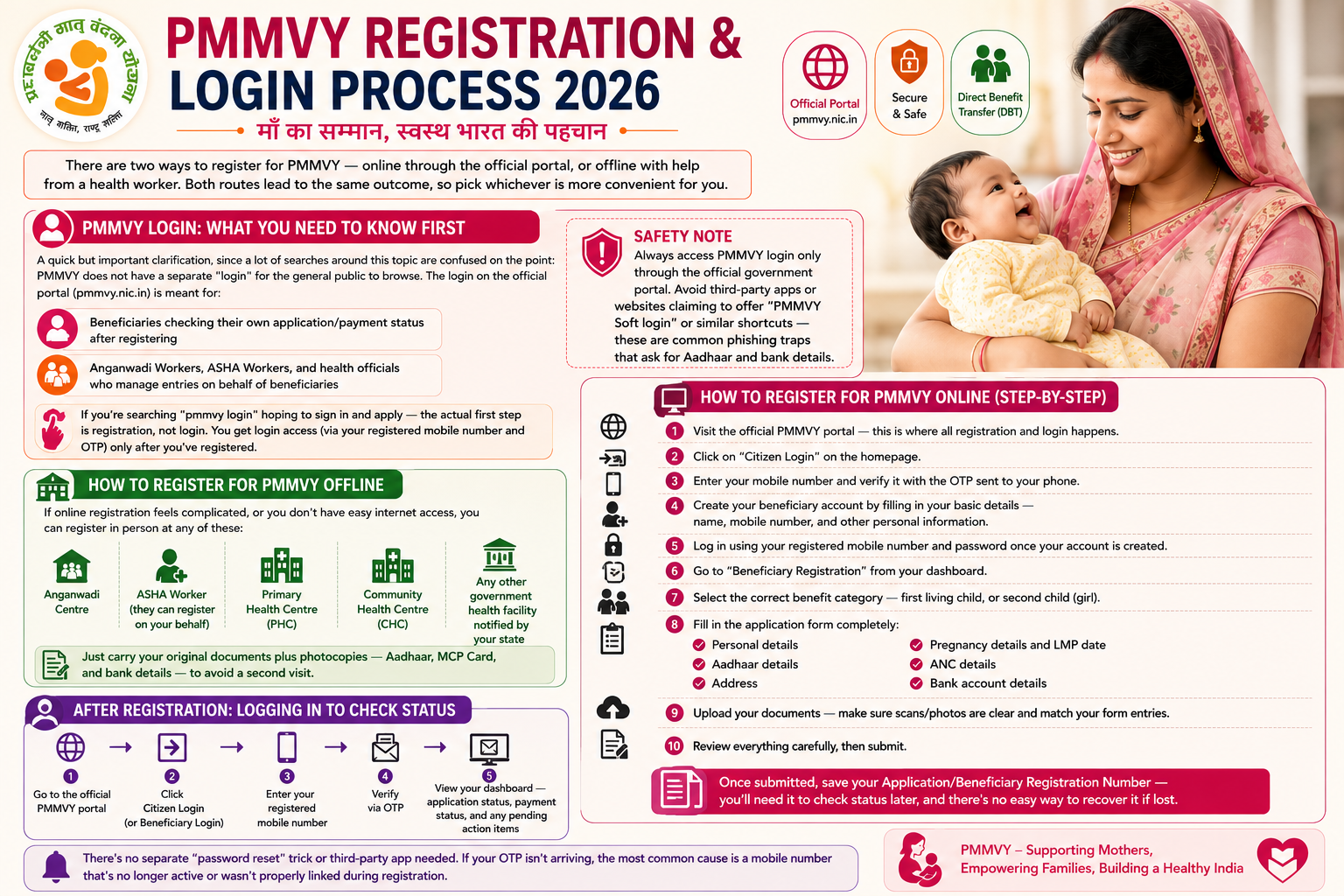
There are two ways to register for PMMVY — online through the official portal, or offline with help from a health worker. Both routes lead to the same outcome, so pick whichever is more convenient for you.
PMMVY Login: What You Need to Know First
A quick but important clarification, since a lot of searches around this topic are confused on the point: PMMVY does not have a separate "login" for the general public to browse. The login on the official portal (pmmvy.nic.in) is meant for:
Beneficiaries checking their own application/payment status after registering.
Anganwadi Workers, ASHA Workers, and health officials who manage entries on behalf of beneficiaries.
If you're searching "PMMVY Login" hoping to sign in and apply — the actual first step is registration, not login. You get login access (via your registered mobile number and OTP) only after you've registered.
⚠️ Safety Note
Always access PMMVY login only through the official government portal. Avoid third-party apps or websites claiming to offer "PMMVY Soft Login" or similar shortcuts — these are common phishing traps that ask for Aadhaar and bank details.
How to Register for PMMVY Online (Step-by-Step)
Visit the official PMMVY portal — this is where all registration and login happens.
Click on "Citizen Login" on the homepage.
Enter your mobile number and verify it with the OTP sent to your phone.
Create your beneficiary account by filling in your basic details — name, mobile number, and other personal information.
Log in using your registered mobile number and password once your account is created.
Go to "Beneficiary Registration" from your dashboard.
Select the correct benefit category — first living child, or second child (girl).
Fill in the application form completely:
- Personal details
- Aadhaar details
- Address
- Pregnancy details and LMP date
- ANC details
- Bank account details
Upload your documents — make sure scans/photos are clear and match your form entries.
Review everything carefully, then submit.
Once submitted, save your Application/Beneficiary Registration Number — you'll need it to check status later, and there's no easy way to recover it if lost.
How to Register for PMMVY Offline
If online registration feels complicated, or you don't have easy internet access, you can register in person at any of these:
Just carry your original documents plus photocopies — Aadhaar, MCP Card, and bank details — to avoid a second visit.
After Registration: Logging In to Check Status
There's no separate "password reset" trick or third-party app needed. If your OTP isn't arriving, the most common cause is a mobile number that's no longer active or wasn't properly linked during registration.
How to Check Your PMMVY Application Status
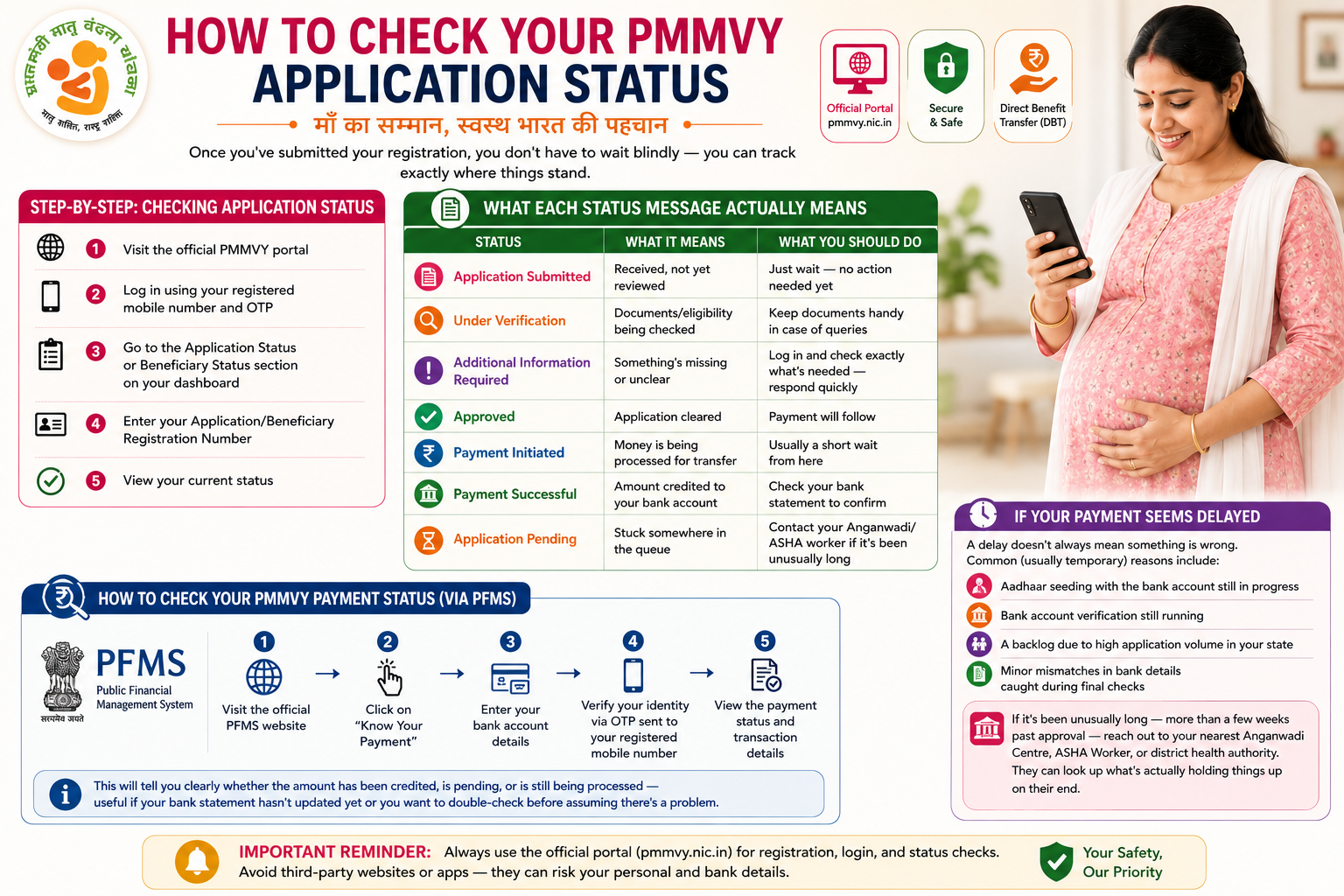
Once you've submitted your registration, you don't have to wait blindly — you can track exactly where things stand.
Step-by-Step: Checking Application Status
Visit the official PMMVY portal.
Log in using your registered mobile number and OTP.
Go to the Application Status or Beneficiary Status section on your dashboard.
Enter your Application/Beneficiary Registration Number.
View your current application status.
What Each Status Message Actually Means
| Status | What It Means | What You Should Do |
|---|---|---|
| Application Submitted | Received, not yet reviewed. | Just wait — no action needed yet. |
| Under Verification | Documents/eligibility being checked. | Keep documents handy in case of queries. |
| Additional Information Required | Something's missing or unclear. | Log in and check exactly what's needed — respond quickly. |
| Approved | Application cleared. | Payment will follow. |
| Payment Initiated | Money is being processed for transfer. | Usually a short wait from here. |
| Payment Successful | Amount credited to your bank account. | Check your bank statement to confirm. |
| Application Pending | Stuck somewhere in the queue. | Contact your Anganwadi/ASHA Worker if it's been unusually long. |
How to Check Your PMMVY Payment Status (via PFMS)
If your application is already approved, you can independently verify the payment through the Public Financial Management System (PFMS) — this is separate from the PMMVY portal itself.
This will tell you clearly whether the amount has been credited, is pending, or is still being processed — useful if your bank statement hasn't updated yet or you want to double-check before assuming there's a problem.
If Your Payment Seems Delayed
A delay doesn't always mean something is wrong. Common (usually temporary) reasons include:
If it's been unusually long — more than a few weeks past approval — reach out to your nearest Anganwadi Centre, ASHA Worker, or district health authority. They can look up what's actually holding things up on their end.
Common Reasons PMMVY Applications Get Rejected or Delayed
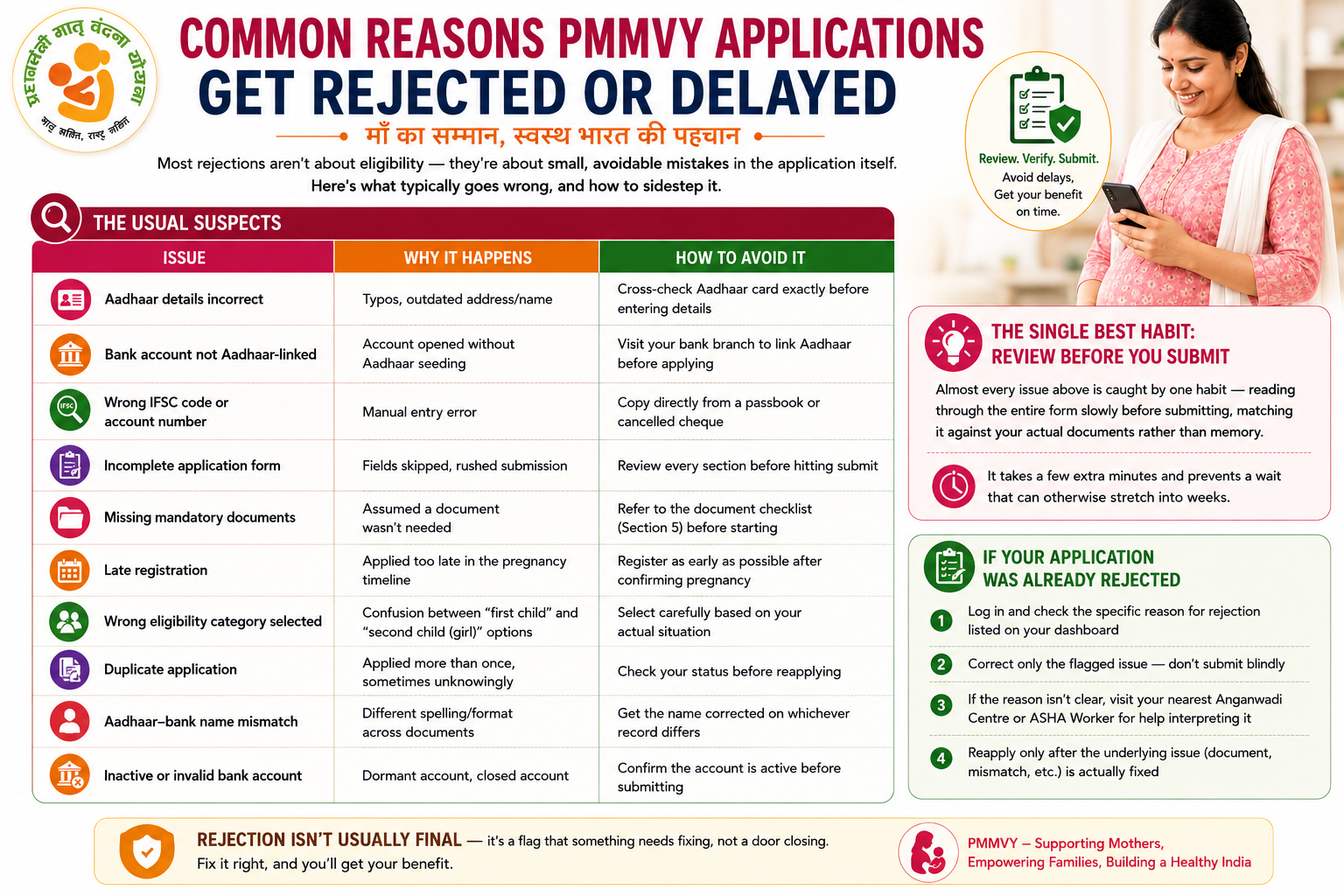
Most rejections aren't about eligibility — they're about small, avoidable mistakes in the application itself. Here's what typically goes wrong, and how to sidestep it.
The Usual Suspects
| Issue | Why It Happens | How to Avoid It |
|---|---|---|
| Aadhaar details incorrect | Typos, outdated address/name. | Cross-check Aadhaar card exactly before entering details. |
| Bank account not Aadhaar-linked | Account opened without Aadhaar seeding. | Visit your bank branch to link Aadhaar before applying. |
| Wrong IFSC code or account number | Manual entry error. | Copy directly from a passbook or cancelled cheque. |
| Incomplete application form | Fields skipped, rushed submission. | Review every section before hitting submit. |
| Missing mandatory documents | Assumed a document wasn't needed. | Refer to the document checklist (Section 5) before starting. |
| Late registration | Applied too late in the pregnancy timeline. | Register as early as possible after confirming pregnancy. |
| Wrong eligibility category selected | Confusion between "first child" and "second child (girl)" options. | Select carefully based on your actual situation. |
| Duplicate application | Applied more than once, sometimes unknowingly. | Check your status before reapplying. |
| Aadhaar–bank name mismatch | Different spelling/format across documents. | Get the name corrected on whichever record differs. |
| Inactive or invalid bank account | Dormant account, closed account. | Confirm the account is active before submitting. |
The Single Best Habit: Review Before You Submit
Almost every issue above is caught by one habit — reading through the entire form slowly before submitting, matching it against your actual documents rather than memory. It takes a few extra minutes and prevents a wait that can otherwise stretch into weeks.
If Your Application Was Already Rejected
Log in and check the specific reason for rejection listed on your dashboard.
Correct only the flagged issue — don't resubmit blindly.
If the reason isn't clear, visit your nearest Anganwadi Centre or ASHA Worker for help interpreting it.
Reapply only after the underlying issue (document, mismatch, etc.) is actually fixed.
Rejection isn't usually final — it's a flag that something needs fixing, not a door closing.
Conclusion
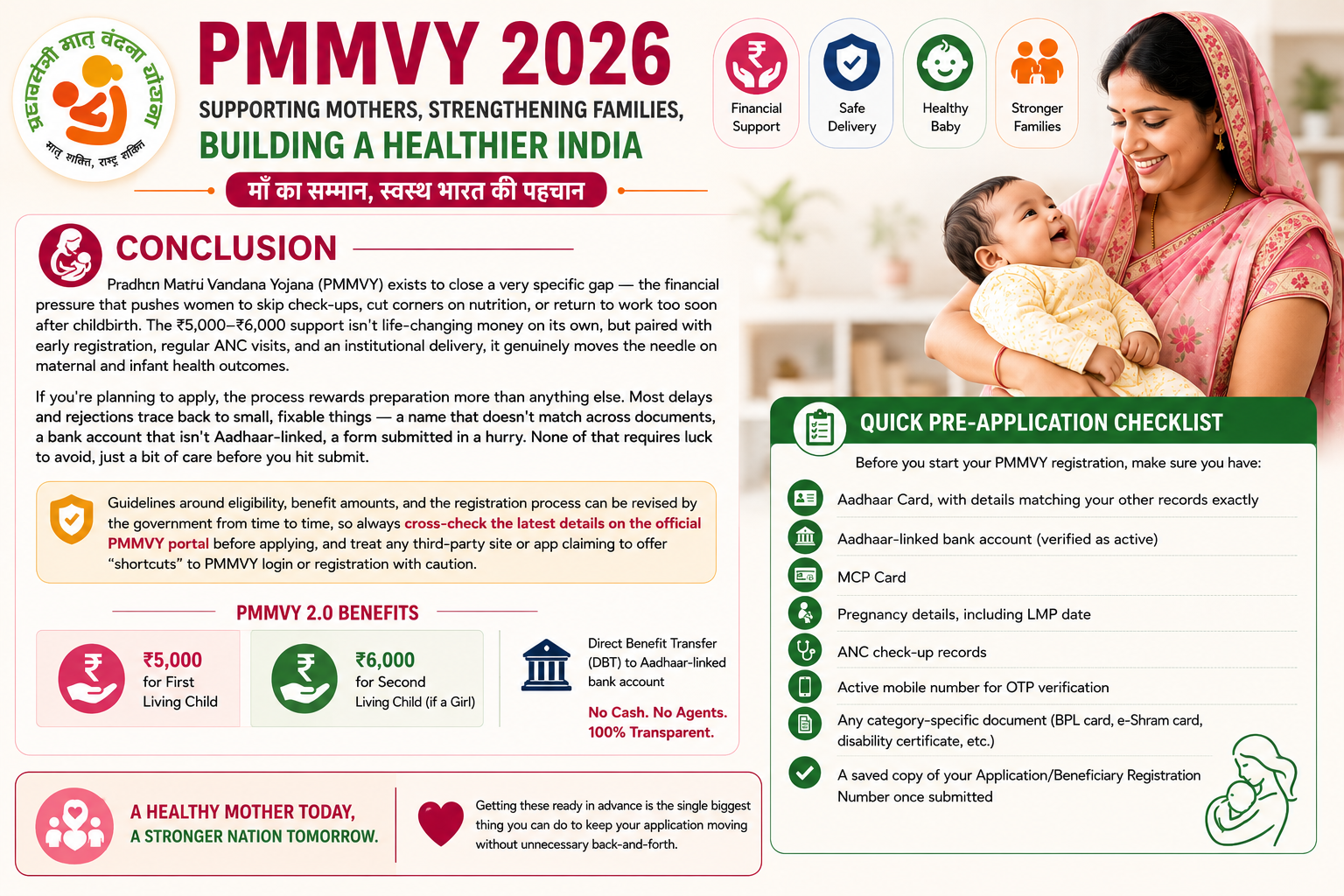
Pradhan Mantri Matru Vandana Yojana (PMMVY) exists to close a very specific gap... — the financial pressure that pushes women to skip check-ups, cut corners on nutrition, or return to work too soon after childbirth. The ₹5,000–₹6,000 support isn't life-changing money on its own, but paired with early registration, regular ANC visits, and an institutional delivery, it genuinely moves the needle on maternal and infant health outcomes.
Apply Carefully & Prepare in Advance
If you're planning to apply, the process rewards preparation more than anything else. Most delays and rejections trace back to small, fixable things — a name that doesn't match across documents, a bank account that isn't Aadhaar-linked, or a form submitted in a hurry. None of that requires luck to avoid, just a bit of care before you hit submit.
Important Guidelines
Guidelines around eligibility, benefit amounts, and the registration process can be revised by the government from time to time, so always cross-check the latest details on the official PMMVY portal before applying, and treat any third-party site or app claiming to offer "shortcuts" to PMMVY login or registration with caution.
Quick Pre-Application Checklist
Before you start your PMMVY registration, make sure you have:
Aadhaar Card, with details matching your other records exactly.
Aadhaar-linked bank account (verified as active).
MCP Card.
Pregnancy details, including LMP date.
ANC check-up records.
Active mobile number for OTP verification.
Any category-specific document (BPL card, e-Shram card, disability certificate, etc.).
A saved copy of your Application/Beneficiary Registration Number once submitted.
Getting these ready in advance is the single biggest thing you can do to keep your application moving without unnecessary back-and-forth.